
AI Technology Brief
Automated subcontractor quote extraction: what it can and cannot safely do
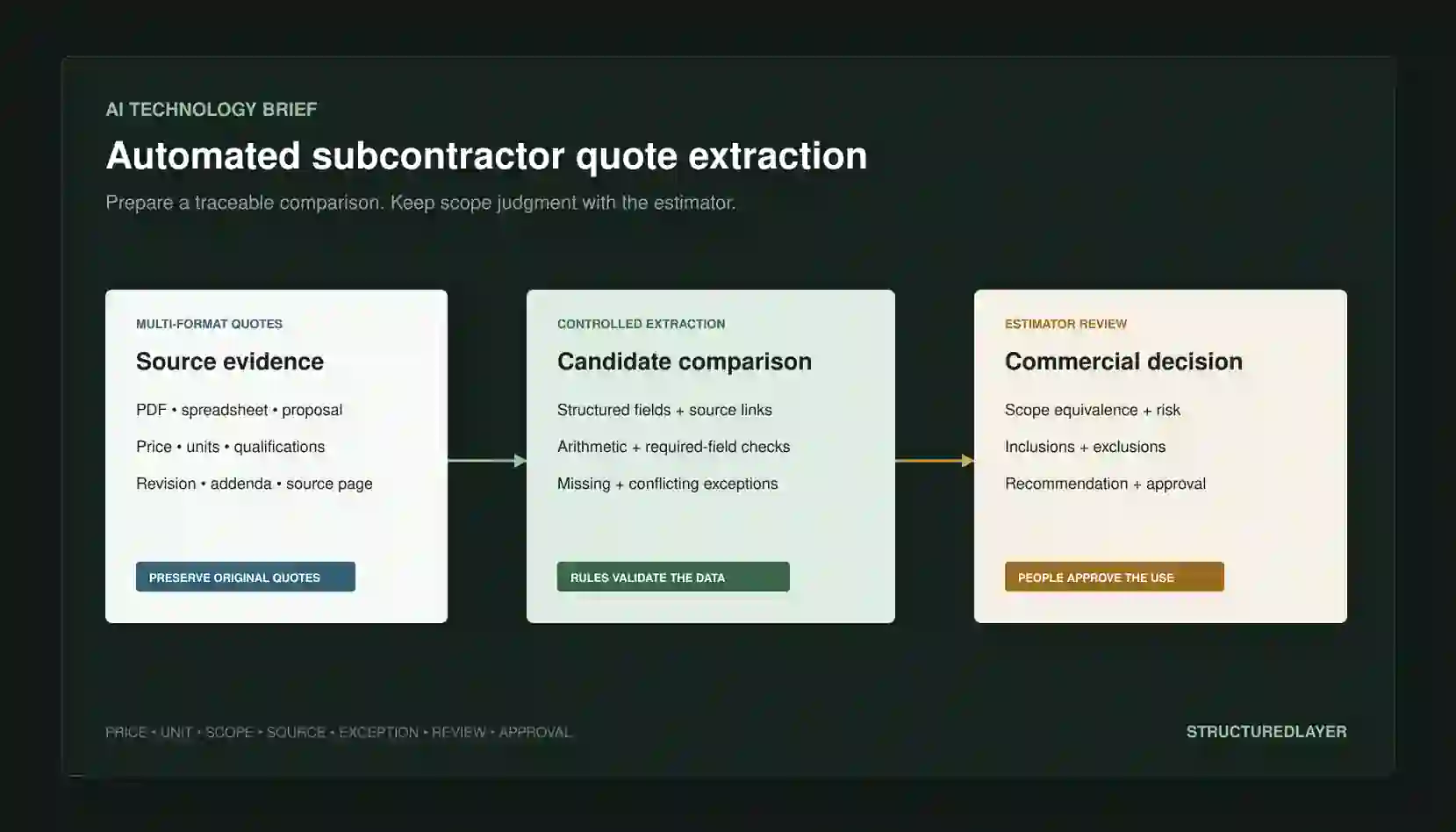
Subcontractor quotes rarely arrive in one consistent format. Document-extraction technology can assist with the first stage of comparison by reducing re-keying while preserving the evidence and exceptions an estimator needs to review.
01 — What happened
General document-processing platforms can prepare structured extraction results.
Amazon Textract can return detected expense summary fields, line-item groups, source blocks, and confidence values. Microsoft Azure Document Intelligence supports custom extraction from structured, semi-structured, and unstructured documents, including labeled fields and tables. Google Cloud Document AI supports custom entity extraction for new document types and provides confidence and source-reference structures in processing responses.
These are general document-processing capabilities rather than construction-specific bid-comparison systems. A construction workflow still needs its own field definitions, scope structure, validation rules, and approval boundaries.
02 — What has been verified
The services can return structured fields, tables, provenance, and confidence signals.
AWS documents detected summary fields and line-item groups with label, value, geometry, page, currency, and confidence information. Microsoft documents structured JSON from custom extraction models and confidence at field, word, table, row, and cell levels where supported by the selected model and API version. Google documents custom entities and processing responses with confidence, text anchors, page anchors, nested properties, and normalized values where supported by the processor and schema.
These capabilities do not establish that a model will understand every subcontractor quote. Confidence is an estimate, not proof. Thresholds and review routing must be calibrated against the actual trades, vendors, languages, layouts, scans, commercial conventions, and risks used by the business.
03 — Why construction businesses should care
Common quote information can reach a review queue sooner.
A controlled extraction workflow can reduce copying and make missing values and differences more visible, provided every result remains linked to source evidence.
- Subcontractor and contact details
- Quote number and issue date
- Project and tender reference
- Trade or work package
- Base price and tax treatment
- Labour, material, and equipment breakdowns
- Quantities, units, and unit rates
- Alternates and allowances
- Inclusions, exclusions, and qualifications
- Proposed schedule or lead time
- Quote-validity period
- Bonds, insurance, or payment terms
- Addenda acknowledged
04 — Possible construction and property use cases
Extraction can prepare comparison work without making the commercial decision.
- Preparing first-pass bid-comparison tables
- Flagging bids that omit required scope sections
- Comparing alternates and allowances across bidders
- Checking whether listed addenda were acknowledged
- Normalizing common units and currencies for review
- Linking each extracted value to its quote, page, and location
- Building a searchable history of subcontractor pricing
- Identifying unusual price differences for estimator investigation
- Creating draft subcontractor recommendation records
- Preparing approved quote information for project handoff
Historical pricing should only be reused when the system preserves project, location, date, quantity, specification, market conditions, and scope context. A number without that context can create a misleading benchmark.
05 — What the technology still cannot safely do
Extraction does not prove that two prices cover the same work.
A model may fail to recognize that:
- One quote excludes access equipment or temporary works.
- Different bidders interpreted drawing boundaries differently.
- A qualification changes contractual risk rather than price.
- An allowance is provisional while another figure is fixed.
- A unit rate applies only above a minimum quantity.
- An alternate duplicates or replaces part of the base scope.
- A handwritten note changes a typed inclusion.
- A tax, currency, or escalation assumption differs.
- The quote was based on an outdated drawing or addendum.
It should not autonomously determine bid compliance, approve a subcontractor, change an estimate, issue a purchase order, or make a contractual commitment.
06 — Data and workflow requirements
The extraction layer needs a defined target record.
- Project, opportunity, and work-package identifiers
- Bidder company and contact identifiers
- Source file, email, or portal record
- Document version, received date, and revision state
- Extracted field name, raw value, and normalized value
- Currency, unit, quantity, and tax basis
- Page, table, row, or bounding-region reference
- Extraction method and model version
- Confidence or validation state
- Exception reason and assigned reviewer
- Human correction, approval, and timestamp
- Link to the final comparison and estimate version
Receive quote
  -> identify project, bidder and work package
  -> preserve the original document
  -> classify document and extract candidate fields
  -> validate formats, totals and required fields
  -> route uncertain or conflicting values to review
  -> align approved values to the comparison structure
  -> complete estimator scope review
  -> approve the commercial decision separately
07 — Deployment choices
Prebuilt, custom, and combined pipelines carry different operating costs.
Prebuilt document service
Faster to test, but invoice or expense schemas may not capture construction-specific qualifications and scope boundaries.
Custom extractor
Allows business-specific fields and varying layouts, but requires representative examples, labeling, testing, and ongoing monitoring.
Combined pipeline
Uses OCR or parsing for source text, deterministic rules for checks, and AI for bounded classification or normalization. It is flexible but requires more engineering and governance.
Hosted services introduce usage charges, storage architecture, data-location decisions, and vendor-specific limits. Self-hosted models still require compute, engineering, security, monitoring, and maintenance. Neither route is automatically cheaper or safer without measuring actual volume and operating requirements.
08 — Security and human-review considerations
Quotes contain confidential pricing, terms, contacts, and project information.
- Which documents may be sent to each processing service
- Storage location, retention, and deletion rules
- Role-based access to quotes and comparison records
- Whether model providers retain or use submitted data
- Encryption and credential management
- Audit history for extracted and corrected values
- Thresholds and rules for mandatory review
- Separation between data preparation and commercial approval
Confidence scores can prioritize review, but they are not a guarantee of correctness. A high-confidence value can still be commercially misleading when it comes from the wrong scope section or is mapped to the wrong field.
09 — StructuredLayer's practical view
Automated quote extraction is ready for a controlled pilot when it prepares a traceable first-pass comparison—not when it replaces estimator judgment. Every material price, inclusion, exclusion, alternate, and qualification should remain linked to its source and review state before it affects an estimate, recommendation, or commitment.
Start with one work package, a representative set of historical quotes, and a small field list. Measure field-level accuracy, correction time, missed qualifications, false matches, and reviewer effort. Expand only after exceptions are visible and the original evidence remains easy to inspect.
10 — Primary sources
Capability and risk claims remain linked to official documentation.
Amazon Web Services
Amazon Textract: AnalyzeExpense API
Microsoft Azure Document Intelligence
Custom document models
Microsoft Azure Document Intelligence
Interpret accuracy and confidence scores
Google Cloud Document AI
Custom Extractor overview
Google Cloud Document AI
Handle the processing response
NIST
Artificial Intelligence Risk Management Framework 1.0
Sources reviewed 21 July 2026