
AI Technology Brief
Baidu releases an open OCR model for long documents
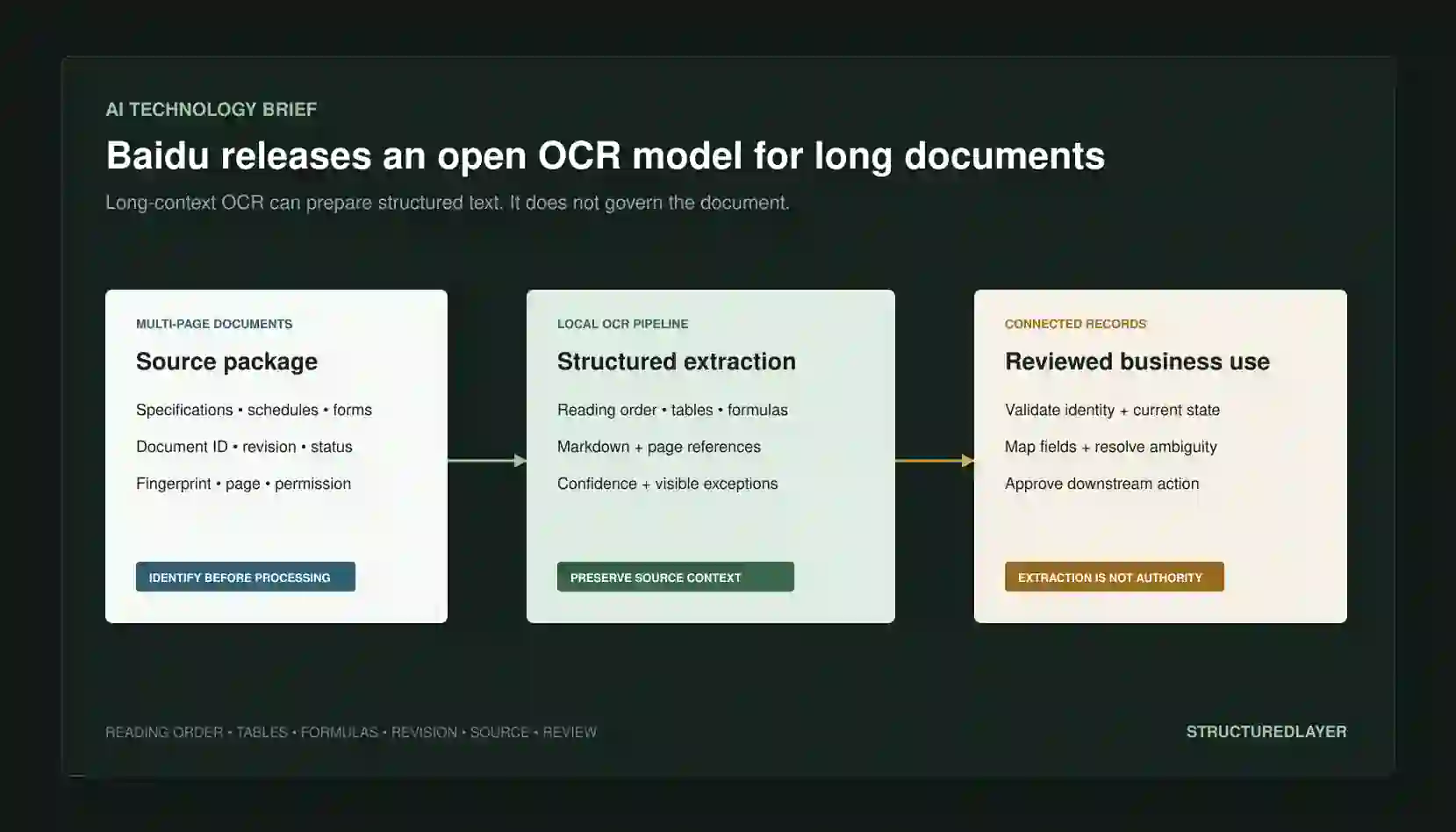
Unlimited-OCR can process multiple document pages in one pass, but dependable business use still requires source identity, revisions, validation, permissions, exceptions, and human review.
01 — What happened
Baidu published an open-weight model for long-document parsing.
Baidu has released Unlimited-OCR, an MIT-licensed, open-weight document-parsing model designed to process multiple document pages in one continuous pass.
Traditional OCR pipelines commonly process pages separately, making it harder to preserve reading order, tables, formulas, and context across page boundaries. Unlimited-OCR replaces decoder attention layers with Reference Sliding Window Attention. Generated tokens retain access to fixed visual and prompt context while attending to a bounded window of recent generated tokens.
02 — What has been verified
Published claims remain attributed research results.
3B
Total parameters; the paper reports approximately 500M activated parameters during inference.
32K
Maximum training sequence length; documented deployments use a 32,768-token configuration.
93.23
Author-reported OmniDocBench v1.5 overall score versus 87.01 for the continue-trained DeepSeek-OCR baseline.
6.22 points
Absolute reported improvement over that baseline, not a percentage accuracy claim.
0.1069
Author-reported edit distance for the paper's small in-house 40-plus-page category.
MIT
Model-card licence. Compute, engineering, storage, monitoring, validation, and maintenance are not free.
The benchmark covers text, formulas, tables, and reading order. Unlimited-OCR was continue-trained from the DeepSeek-OCR checkpoint for 4,000 steps on approximately two million document samples, so the comparison does not isolate the attention architecture alone.
03 — Why businesses should care
Cross-page context could reduce fragmentation in document workflows.
The capability could improve reviewable structured outputs from contracts, specifications, tenders, schedules, manuals, and reports. Business value does not come from extracted text alone. It comes from connecting that output to the correct record, revision, source, owner, validation state, and downstream decision.
04 — Possible construction, property and business use cases
Useful tasks remain bounded by source quality and authority.
- Multi-page contract extraction
- Specification and tender-document parsing
- Schedule-of-values capture
- Subcontractor bid comparison
- Drawing-register preparation
- Operations-manual indexing
- Cross-page table extraction
- Source-linked document search
05 — What the model still cannot safely do
Parsing does not establish truth, authority, or permission.
- It cannot determine which document revision is contractually authoritative without governed source and status records.
- It cannot safely approve commercial, contractual, engineering, safety, payment, or compliance decisions.
- Tables, formulas, reading order, small text, scans, annotations, and unusual layouts still require representative testing.
- A benchmark score does not establish performance on a company's documents, languages, drawing conventions, or exception cases.
- A 32K configured length is finite and does not establish unlimited context or reliable parsing of every long document.
- Extracted text is not automatically a verified business record or permission to trigger downstream action.
06 — Data and workflow requirements
OCR output needs a governed operating record.
Before extracted information can support search, reporting, approvals, or AI actions, the workflow should define:
- Stable project and document identifiers
- Document type, status, and revision fields
- Source-file, page, and section references
- Validation rules and expected formats
- Confidence, exception, and review fields
- Permission and retention controls
- Named ownership for correction and approval
- Operating records for model, prompt, tools, outputs, cost, and disposition
07 — Deployment choices
Open weights create options, not zero-cost operation.
Controlled local or private deployment
The model card documents Transformers, vLLM, and SGLang. Primary examples use NVIDIA CUDA hardware, BF16 weights, model-specific code, and trust_remote_code=True. Minimum GPU, VRAM, latency, throughput, CPU-only support, and Apple Silicon support are not established.
Hosted Baidu document parsing
Baidu documents an asynchronous API returning Markdown and JSON. It currently describes limited-time testing resources of 200 pages for identity-verified individuals and 1,000 pages for identity-verified enterprises. It does not establish permanent free use, production pricing, an availability SLA, or recurring free allowances.
Local deployment may avoid a per-page OCR API charge, but GPU infrastructure, engineering, storage, monitoring, security, validation, and maintenance still carry costs.
08 — Security and human-review considerations
Document access and consequential decisions remain controlled.
Deployment security
Review model code, weights, dependencies, containers, network access, logging, retention, storage, updates, and vendor terms before protected documents are processed.
Document permissions
Preserve source permissions. A model's ability to read a file does not authorize every user or agent to access it.
Human validation
Commercial, contractual, engineering, safety, payment, compliance, and external-communication decisions require authorized human review.
Exception handling
Missing pages, superseded revisions, ambiguous tables, low-quality scans, conflicts, and low-confidence outputs should enter visible review queues.
09 — StructuredLayer's practical view
This is an important document-intelligence capability, but it does not replace document governance. Before extracted information can trigger reports, approvals, or AI actions, it must be connected to the correct project, revision, owner, source, permission, and validation state.
A controlled pilot should use representative documents, expected outputs, difficult cases, permission tests, review effort, failure criteria, operating cost, and a clear proceed, narrow, prepare, or stop recommendation.
10 — Primary sources
Claims remain linked to their technical origin.
arXiv technical report
Unlimited OCR: Scaling Document Parsing to Hundreds of Millions of Tokens
Hugging Face
baidu/Unlimited-OCR model card
Baidu AI Cloud
Unlimited-OCR hosted document-parsing API
Sources and service terms reviewed 20 July 2026