Company video
See how we prepare business data for the AI era.
StructuredLayer helps construction and property teams connect scattered records, documents, workflows, approvals, and exceptions into a client-owned operating layer, then add bounded agents and practical team training.
StructuredLayer in plain language
Your business already has a workflow. The problem is that its truth is scattered.
One part may live in a spreadsheet, another in an inbox, another in project software, and the reason behind a decision may exist only in someone's memory. People spend time searching, copying, checking, asking, and rebuilding context before they can move the work forward.
StructuredLayer helps a construction or property organization turn that scattered reality into one visible operating system for a defined workflow.
We identify where reliable information comes from, how records relate, which fields matter, who owns each stage, what requires approval, what can be automated, and what must happen when the normal path breaks. Then we implement the agreed boundary using appropriate databases, interfaces, integrations, document processing, workflow controls, and bounded AI.
The goal is not to hide the operation behind a mysterious model. The goal is to make the work easier to see, control, review, transfer, and improve.
The operating architecture
Data first. Workflow second. Controlled AI third.
Automation becomes dependable only when it has current records and explicit operating rules beneath it. StructuredLayer treats those dependencies as three connected layers rather than three separate technology projects.
Data Layer
A connected, client-owned record of the companies, contacts, projects, sites, RFQs, bids, documents, revisions, decisions, and exceptions that matter to the selected workflow.
The boundary: Sources, identity, relationships, field definitions, provenance, permissions, and change history.
Workflow Layer
A visible operating path that defines how work enters, who owns it, what must be present, which decision comes next, and what happens when the normal route fails.
The boundary: Stages, assignments, deadlines, approval gates, completion rules, reminders, and exception paths.
Automation and AI Layer
Deterministic actions and bounded assistance operate only within the approved context, tools, permissions, and review boundary for a named task.
The boundary: Explicit rules, scoped tools, source evidence, reviewable drafts, monitoring, recovery, human authority, and action limits.
A clean dashboard is useful, but it is not the operating layer by itself. The real value is the maintained connection between source evidence, shared records, workflow rules, human responsibility, and the next bounded action.
Explore the three-layer modelA maintained agent loop
This is not a one-time data import.
A useful operating layer keeps changing as the business changes. New opportunities appear, documents are revised, due dates move, approvals arrive, exceptions surface, and ownership changes. Approved connections and bounded agents repeat defined work so the shared records can stay current.
01
Trigger
A schedule, new record, changed status, received document, or approved user action starts the run.
02
Fetch
The connection reads only the permitted source, whether that is an API, connector, database, inbox, document flow, or authorized interface.
03
Compare
Current source state is matched against known records so the system can distinguish a new fact, a revision, a conflict, and a duplicate.
04
Validate
Required fields, relationships, formats, permissions, and business rules are checked before shared state changes.
05
Write or review
Accepted values enter defined fields with provenance. Uncertain or consequential cases pause for a named person.
06
Repeat
The next approved trigger runs the same bounded process again, keeping the operating layer current over time.
The practical result
People and authorized agents can review the same current state. A dashboard shows what needs attention; an approval records human authority; the next agent receives only the records and fields assigned to its task.
How organizations can start
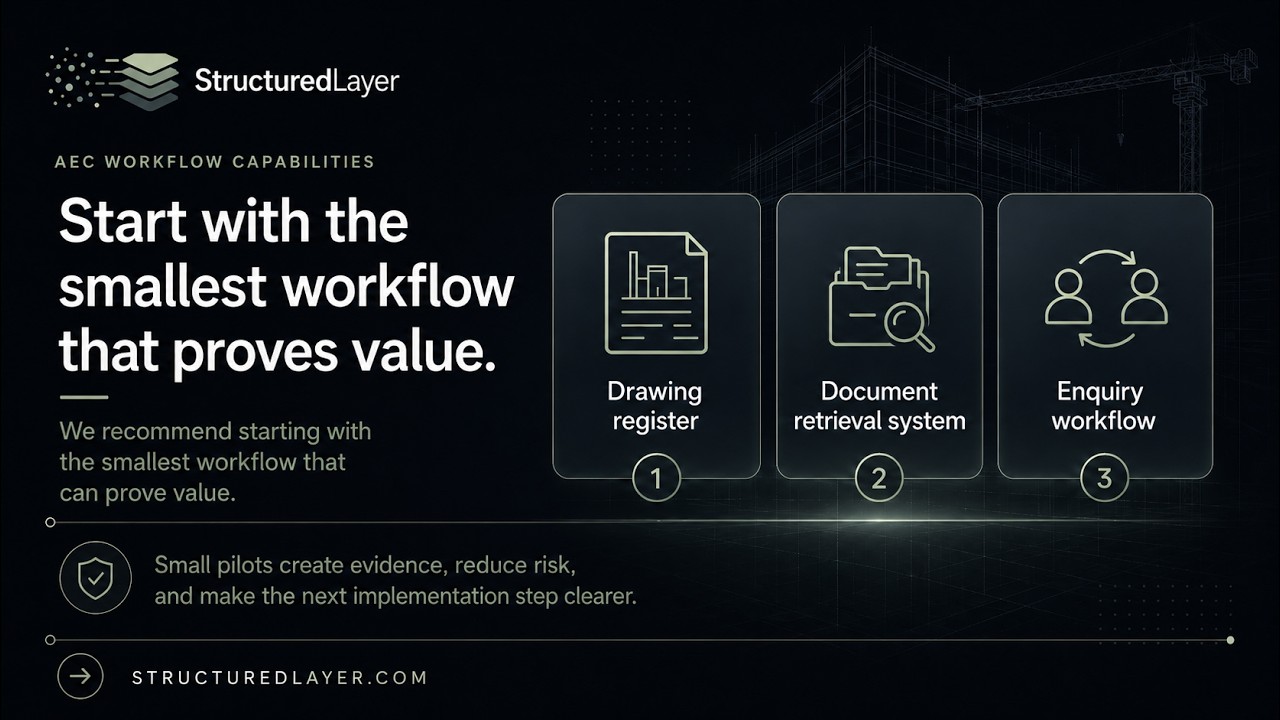
Start with one operating problem and increase commitment only when the boundary is clear.
StructuredLayer uses defined engagement levels so a company does not need to commit to a large transformation before the workflow, evidence, access, ownership, and expected result are understood.
Level 0
Workflow Assessment
Free
Usually 15-20 minutes; detailed submissions may take up to 30 minutes
Describe one workflow, the people and tools involved, its failure points, and the desired result. StructuredLayer reviews whether the requirement is specific and credible enough for a useful next step.
Start the assessmentLevel 1
Operating-Layer Blueprint
$3,500 fixed
Approximately 10 business days
Document current state, target controls, systems, field structure, access, assumptions, responsibilities, exclusions, acceptance criteria, implementation phases, and a priceable delivery boundary.
Review Blueprint detailsLevel 2
Single Workflow Implementation
$9,500-$17,500
Typically 4-8 weeks
Configure the records, workflow stages, interfaces, integrations, permissions, notifications, reports, and approved automation for one bounded process, then validate and hand it over.
Explore implementationImplementation amounts are USD planning guidance, not quotes. A written proposal confirms the final scope, assumptions, responsibilities, exclusions, timeline, price, payment stages, security requirements, and acceptance criteria.
Agents with operating boundaries
AI receives a job description, not unlimited access.
An agent should know where it may read, which records and fields it may change, what evidence it must keep, when it must stop, and who has authority over the result. Those instructions are part of the operating system, not an afterthought.
Preferred connection
Use an API, webhook, or supported connector when one exists.
Scoped credentials, typed requests, response codes, webhook events, and logs usually make the integration easier to constrain, test, and observe. The connection should still expose retries, failed validation, rate limits, and ownership.
When no suitable API exists
A browser or computer-vision agent can act like a scoped operator.
Where use is authorized, the agent can read visible state, enter approved values, navigate defined screens, and record evidence. Platform terms, permissions, credentials, MFA, CAPTCHA, rate limits, interface changes, error recovery, and human approval remain hard boundaries.
Limited tools
Expose only the actions required by the task.
Visible evidence
Preserve sources, proposed changes, run state, and exceptions.
Human authority
Pause consequential, uncertain, or policy-sensitive actions for review.
Where the method can be applied
The model stays consistent even when the workflow changes.
Every implementation has different sources, fields, people, restrictions, and acceptance criteria. These workflow pages describe reusable operating patterns, not claims that every organization should use the same process.
RFQ to bid
Control qualification, document revisions, estimator ownership, approvals, submission, and follow-up.
Review this workflowBid portal ingestion
Capture approved opportunity data from source portals while preserving source and review boundaries.
Review this workflowSubcontractor onboarding
Coordinate company records, compliance evidence, review status, approvals, and exceptions.
Review this workflowManagement reporting
Build recurring reporting from governed operating records instead of disconnected manual summaries.
Review this workflowOpportunity to market network
Connect opportunity records to relevant organizations and controlled outreach preparation.
Review this workflowVerified contractor database
Maintain contractor identities, capabilities, documents, classifications, and review state.
Review this workflowTraining, ownership, and handover
Your team should be able to use the system, question it, and improve it.
Implementation is incomplete if the client cannot understand the operating rules or respond when normal assumptions fail.
Role-based practice
People work through representative scenarios in the tools and interfaces relevant to their responsibilities rather than only watching a demonstration.
Responsible AI readiness
With informed participation and organizational approval, exercises can identify where people need support with task framing, data protection, output checking, and escalation. They are coaching inputs, not covert monitoring, employee ranking, or automated employment decisions.
Operating documentation
Named owners, field definitions, review rules, exception paths, access assumptions, and handover instructions remain visible to the organization.
Relevant technical updates
Briefings can translate new AI models, tools, and technical launches into what changed, what remains experimental, which boundary applies, and what a team should evaluate next.
Founder accountability
Usman Yousaf founded StructuredLayer around a practical operating belief.
Read Usman's profileAI becomes more dependable when it works from current governed data, explicit workflow rules, visible evidence, and human authority.
Usman's verified background includes more than 2.5 years as a Solution Architect at ByteSpace.ai and 1.5 years working directly with Preswerx leadership. His StructuredLayer responsibilities include engagement qualification, operating-boundary design, specialist coordination, and implementation accountability.
StructuredLayer does not use that background as proof of client outcomes. Each new engagement still needs its own evidence, scope, access review, testing, acceptance criteria, and written agreement.
Frequently asked questions
What organizations usually need to know before starting.
Read the complete FAQWhat is StructuredLayer?
StructuredLayer is an implementation practice for construction and property organizations that need their records, documents, systems, people, approvals, and exceptions to work as one controlled operating system. It designs and implements a governed data layer, explicit workflow controls, useful interfaces, integrations, and bounded automation around a defined business workflow.
Does StructuredLayer replace the software a company already uses?
Usually, no. StructuredLayer begins by mapping the systems, spreadsheets, inboxes, portals, documents, and databases already involved. It then defines how reliable information should move between them, where the shared operating record should live, and which gaps require a new interface, integration, or controlled agent.
What are the three StructuredLayer operating layers?
The Data Layer holds connected, authoritative records and source evidence. The Workflow Layer defines states, owners, approvals, deadlines, and exception paths. The Automation and AI Layer combines deterministic actions with bounded assistance inside approved operating boundaries.
Can StructuredLayer connect a system that has no API?
APIs and supported connectors are preferred. When no suitable API exists and the use is authorized, a scoped browser or computer-vision agent may read visible state, enter approved values, and preserve evidence. Platform terms, permissions, credentials, MFA, CAPTCHA, rate limits, error recovery, and human approval still define what the agent may do.
How much does StructuredLayer cost?
The Workflow Assessment is free. The Operating-Layer Blueprint is $3,500 fixed within its stated boundary. A bounded single-workflow implementation typically carries planning guidance of $9,500 to $17,500 USD. Final implementation scope and price are confirmed only in a written proposal after the systems, data, access, controls, responsibilities, and acceptance criteria are understood.
How long does a StructuredLayer engagement take?
A Blueprint is planned for approximately 10 business days when participants and evidence are available. A bounded implementation typically takes 4 to 8 weeks. Connected operating layers involving several workflows or systems may require phased delivery. The proposal confirms the actual schedule and dependencies.
Does StructuredLayer train the client team?
Training and handover can include role-based sessions, representative exercises, operating instructions, approval guidance, named ownership, and practical use of the implemented tools. The aim is for the client team to understand, operate, review, and improve the system rather than depend indefinitely on StructuredLayer to run it.
Who founded StructuredLayer?
StructuredLayer was founded by Usman Yousaf. His verified background includes more than 2.5 years as a Solution Architect at ByteSpace.ai and 1.5 years working directly with Preswerx leadership. His role includes engagement qualification, operating-boundary design, specialist coordination, and implementation accountability.
One workflow is enough to begin
Tell us where the information starts, who needs it, and what keeps going wrong.
Do not send passwords, MFA codes, API keys, access tokens, credential exports, private keys, unrestricted production records, or unnecessary sensitive documents.